
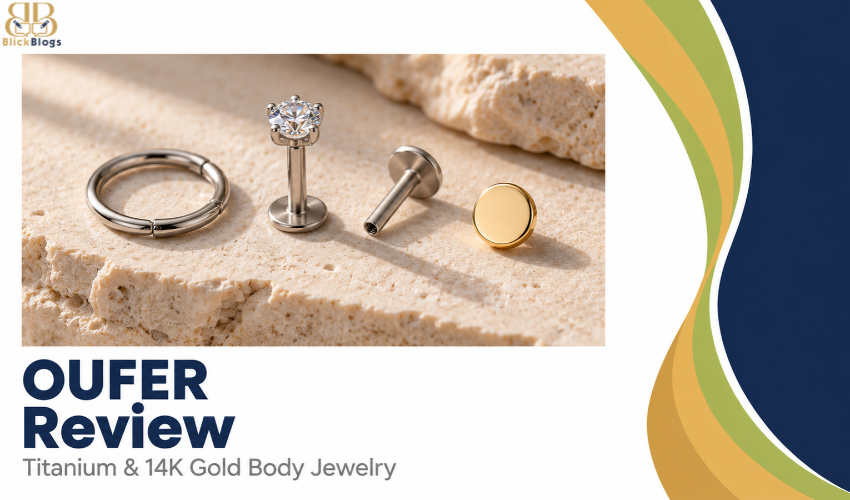
Buying body jewelry online is easy once you know exactly what fits. It gets harder when a ring is listed for several piercings, a stud’s photo shows a complete piece but the selected option is just the top, or the color is called gold while the material is titanium. OUFER has enough variety to make those distinctions worth learning before you order. A low-priced hoop can be a good buy in the right size, while the wrong diameter can make an otherwise appealing design unusable.
This OUFER review compares titanium nose and septum rings, cartilage earrings, 14K gold components and belly button jewelry. The focus is on replacement jewelry for healed piercings, with a separate explanation of why starter jewelry deserves a professional fitting. The assessment draws on OUFER’s listings and return policy, independent customer accounts and professional piercing guidance. It’s a research-based review, and product pages establish what the seller specifies rather than independently testing metal composition, finish or closure durability.
Quick Verdict
OUFER is worth comparing for affordable styles in a healed piercing when you already know your measurements. Simple titanium hoops and flat backs are the easiest place to start. For 14K gold, verify the material of each component and whether the price includes a post. If you need initial jewelry or help with size, a professional piercer can assess the fit in person.
Find Jewelry in the Size You Already Wear
Start with your gauge, then compare hoop diameter or post length and the material listed for the exact option.
Browse OUFER Titanium Jewelry →What Is OUFER Body Jewelry?
OUFER Body Jewelry is an online retailer with collections for nostril, septum, cartilage and navel piercings, among others. The catalog ranges from simple hoops and labrets to themed pieces with cubic zirconia, charms and pendants. OUFER identifies the dot-com storefront as official in its brand statement. Its website also publishes product specifications and contact and return information, useful reference points when a listing appears on more than one marketplace.
You can browse by piercing site, material, theme or style, but product pages are where the important decisions happen. Gauge describes the thickness of the part that goes through the piercing. A hoop’s inner diameter describes the space inside the ring, while a stud’s wearable length describes how much post sits between its ends. Two jewelry pieces can share a gauge and look similar in a photo while leaving entirely different amounts of room once fitted. Treat the category filter as a starting point and the exact option in the cart as the product you’re buying.
OUFER Titanium Nose Rings and Septum Jewelry
Titanium nostril hoops and studs
The 20G nose ring collection lists a plain titanium hinged segment ring alongside decorated hoops. The plain ring is a straightforward option if you want a continuous-looking outline with a hinged closure. Its 20G designation corresponds to 0.8 mm of thickness in OUFER’s listing. Check the inner diameter separately against a ring that fits or a measurement from your piercer. A larger diameter leaves more space between the edge of the nostril and the ring, changing both the look and how much the jewelry can move.
If you want sparkle, the titanium nostril collection also includes CZ segment hoops and threadless studs. Look at where the decoration faces on the product photos and how far it extends from the ring. A row of stones can face outward like trim, while a taller design can look more pronounced from the side. If your goal is a small point of light on the nostril, a stud will give a different profile from a hoop. Note whether the listed millimeter measurement labels the stone, the post or the hoop opening before selecting it.
Septum clickers and horseshoe styles
OUFER’s titanium collection includes hinged septum rings, horseshoe silhouettes and decorated pieces. The Fixed-Ball Titanium Horseshoe Hinged Septum Ring is a useful example of why you should read both the name and mechanism. It gives the visual effect of a horseshoe with balls while using a hinged closure. A conventional circular barbell with removable ends is a different construction, so check the listing if replaceable ends matter to you.
A simple circle and an embellished clicker can have the same wearable diameter but extend different distances below the nose. That matters if you want a close profile for work or regularly wear a mask. Use the seller’s front and side views to judge the decorative span, including how far a bow or gem sits outside the ring’s opening. If you’re choosing between a plain ring and a detailed piece, the plain one makes the easiest reference for size. Then compare the outer shape of the more decorative option against the appearance you want.
Cartilage Earrings and 14K Gold Components
Threadless vs. internally threaded flat backs
OUFER’s Prong CZ Star Heart Titanium Threadless Cartilage Stud comes in heart and star designs, with the choice of a 2 mm or 3 mm CZ. The listing describes ASTM F136 titanium and a threadless push-pin connection. The visible stone choice is separate from the thickness or length of the post. A bigger decorative end shows up more clearly on an ear stack, but it also changes how much space it takes up next to another earring.
The Ball Internally Threaded Titanium Lip Stud is also listed for cartilage placements and comes in 16G with wearable lengths of 6, 8, 10 or 12 mm. OUFER describes it as ASTM F136 titanium and sells it singly. A threadless end stays in place through tension, while an internally threaded end screws into the hollow post. If you already own ends or backs, check with the seller about compatibility before assuming they’ll fit. The same wearable gauge tells you how thick the post is, while the pin or thread connection is a separate specification.
A flat disc changes the shape behind the ear, which may suit someone who dislikes a protruding backing. What you feel day to day still depends on post length, the size of the disc and the angle of the piercing. If you wear over-ear headphones or glasses, consider where the jewelry sits relative to the ear cup or frame. Product photos can show how far the decorative end projects, but evidence from a photo alone is limited when it comes to comfort during sleep or pressure under a headset.
What OUFER’s 14K gold listings include
The 14K Gold Disc Threadless Cartilage Nose Stud illustrates how the catalog sells parts. OUFER lists separate options for the 14K top, the 14K post and the titanium post. The disc comes in several face sizes, and the posts have separate gauge and length selections. If you want a complete stud, confirm you’ve selected both compatible parts. If you already own a matching post, the top alone may be precisely what you need.
A 14K top on a titanium post lets you choose a gold look while keeping the material and cost of the backing separate. If you want gold throughout, check the material of the post as carefully as the material of the front. When browsing gold-tone jewelry generally, look for specific descriptions such as solid gold, coated metal or titanium with a stated finish. Color and material answer different questions. A price comparison between a gold top alone and a complete gold stud will misstate what each option costs to wear.
OUFER Belly Button Rings
The 14K Gold Round CZ Belly Ring is an example of a 14G curved bar with a top and bottom stone. OUFER lists bar lengths from 8 to 16 mm for this model and identifies it as externally threaded. Its gold belly jewelry collection also includes an internally threaded CZ model. That difference is easy to miss in photos that emphasize the stones. Check the selected listing’s closure and length even when comparing products with nearly identical materials and appearance.
For daily use, think about where the lower setting or charm will sit when you’re seated or wearing high-waisted clothing. A short decorative end is a simpler starting point if you want less movement around a waistband. A dangling piece creates a different look and needs more clearance. Navel anatomy also affects how the top and bottom ends sit, so a photo of someone wearing the same bar doesn’t tell you whether it will fit your piercing. Get a fitting if the angle or length is uncertain, particularly before spending on solid gold.
Materials, Fit and What the Listings Can Verify
ASTM F136 refers to a specific titanium alloy standard for surgical implant applications. OUFER names that standard on some listings, including the two flat-back examples above. That wording is a seller specification for a particular product. An alloy label alone is too little evidence to assess the polish, build, fit or compatibility of a finished piece. If documentation matters for your purchase, ask for material records tied to the exact item and verify whether the specification describes all components that contact the piercing.
The Association of Professional Piercers’ initial jewelry guidance addresses material, surface finish, construction and appropriate jewelry fit. Its gold guidance specifies suitable biocompatible alloys of at least 14K that are free of nickel and cadmium, and excludes gold-plated pieces for fresh piercings. The organization also explains why internally threaded or threadless designs keep the wearable surface smooth. For a new or healing piercing, ask a professional piercer to select and fit the jewelry. The example gold belly ring’s external threading is one reason the metal label by itself tells you too little.
For an online purchase, save the product name and chosen variant so you can compare the item you receive with the listing. Confirm the selling unit because a single stud is common and some items explicitly come in multipacks. If the size marking, selected color or parts differ from your order, photograph the pieces and packaging before wearing them. That gives the seller useful information and preserves the condition required under the return policy for an unused item.
OUFER Pricing, Returns and Value
These are examples of displayed US-dollar prices from the linked OUFER listings during research. Store pricing can change between visits and by size or material. Check the complete cost at checkout, including any second component, shipping and tax.
| Example | Displayed price | What that price covers |
| 20G Titanium Hinged Segment Nose Ring | $7.69 | A plain hoop from the 20G collection. Verify the selected diameter. |
| Fixed-Ball Titanium Horseshoe Hinged Septum Ring | $9.79 | A hinged septum design in the titanium collection. |
| Ball Internally Threaded Titanium Lip Stud | $10.99 | One 16G flat-back stud. Choose the wearable length. |
| 14K Gold Disc Threadless Cartilage Nose Stud | $28.89 | The displayed disc-top option. Price a compatible post separately if needed. |
| 14K Gold Round CZ Belly Ring | $188.99 | The listed 14G curved barbell. Verify selected length and price. |
The lower-priced pieces are most compelling when you know the exact size and can order one to check the design before buying several. A cheap hoop in the wrong diameter can cost more to return than it’s worth once postage is factored in. With gold, compare the material of the wearing post, the type of closure and the price for a complete piece. Saving a few dollars on the decorative end has little relevance if you need to purchase a new backing.
OUFER’s return policy advertises a 60-day return or refund guarantee. For a change-of-mind or sizing return, it calls for unused items in original packaging and generally assigns return postage to the customer. The policy also lists a 10% restocking charge on specified materials, including 14K gold, for returns without a quality issue. For reported defects, it asks for order details and photos and states that OUFER covers return shipping for quality issues. Ask support for the exact deadline and return instructions before sending anything back.
Check the Price of the Complete Piece
Compare your exact size and closure, and make sure your cart includes any post or backing you need.
Explore OUFER Body Jewelry →OUFER Pros and Cons
| Pros | Cons |
| Wide selection from plain titanium hoops to decorative septum and cartilage pieces. | Size and material details vary by listing, including within one collection. |
| Some titanium listings name a specific alloy standard and provide clear length options. | Seller material descriptions are only one part of assessing finished jewelry quality. |
| Separate gold and titanium components can suit buyers who already own a compatible back. | The displayed gold price may cover only the top or another single component. |
| Several reviewed titanium items had low displayed prices. | Return shipping and the restocking fee on specified gold returns can erode savings. |
Who Should Buy OUFER?
OUFER is strongest for someone replacing jewelry in a healed piercing who can match a known gauge and length or diameter. The range gives you room to choose between a simple daily piece and a design you’ll wear occasionally. If you already know the size of your everyday jewelry, use that as a reference before comparing your favorite styles. Buying one familiar silhouette is an easier first order than choosing several unfamiliar closures or sizes at once.
| What you want | Where to start |
| A small nostril hoop for a known 20G fitting | Compare the plain titanium hinged segment ring and available inner diameters. |
| A decorative septum ring | Check gauge, wearable diameter and the lower span of the motif. |
| A flat-back cartilage piece | Pick a closure first, then confirm post length and decorative end size. |
| A solid gold accent on an ear stack | Verify whether the selected gold option is a top, a post or an assembled piece. |
Who should choose a piercing studio?
A studio is a better starting point for a fresh piercing, an uncertain size or jewelry that needs to work around a tricky angle. A piercer can look at the actual placement and show you how different post lengths and ring shapes sit. That can save an expensive sizing mistake if you’re considering gold or assembling an ear stack with tight spacing. For gifts, get the recipient’s measurements first or choose a gift arrangement that lets them pick.
What OUFER Reviews Say
The Trustpilot profile includes customers who liked the look and prompt delivery as well as buyers who described loose closures, breakage or difficulty resolving orders. One customer liked the appearance and speed of delivery but reported losing a hoop after a week and questioned the closure. That account is relevant if you’re comparing clasps, though it cannot tell you how often that occurs or whether it applies to another model. Read the report alongside the listing for the exact closure you want.
The OUFER-hosted reviews for the internally threaded flat back also show why model-specific notes matter. One owner described it as a good fit for a forward helix, while another reported difficulty removing the top. Both comments deal with the same product but give different insights into fit and handling. Look for reviews that specify the jewelry and size, and give more weight to those details than to a broad verdict on the entire range.
OUFER vs. BodyArtForms and Maison Miru
| Seller | Comparable offering | Best reason to compare |
| OUFER | Titanium nose and septum rings, flat backs and separately listed 14K pieces. | You want a low-priced decorative piece and already know your fit. |
| BodyArtForms | ASTM F136 titanium segment-ring listings and size filters. | You need a particular gauge and diameter or want to compare multiple styles in one size. |
| Maison Miru | Titanium flat-back Nap Earrings collection. | You want an ear-focused collection and prefer to compare coordinated studs. |
BodyArtForms lists one ASTM F136 titanium segment-ring range from $9.95 to $18.95, with multiple gauge and diameter options. That range starts at 16G, so it’s more useful for comparing a compatible septum or cartilage size than for pricing a 20G nostril hoop. Check whether the segment is hinged or removable when comparing listings. Maison Miru focuses its Nap Earrings range on flat-back ear styling and showed an $80 crystal solitaire example. Verify the selling unit before comparing with a single OUFER stud, and give more weight to fit and closure than to any brand’s comfort language.
Frequently Asked Questions
Is OUFER body jewelry legit?
OUFER operates an identifiable online storefront with product listings, contact information and a published return policy. Third-party buyer experiences vary. Confirm the domain and verify the exact product, size and return terms before ordering.
Does OUFER use ASTM F136 titanium?
Some OUFER listings describe the item as ASTM F136 titanium, including the reviewed internally threaded ball labret and threadless CZ cartilage stud. Check the individual product for that specification. If you need documentation, request it for the exact piece and component.
How do I choose an OUFER nose ring size?
Match the gauge of your current jewelry and check the inner diameter separately. A matching gauge doesn’t tell you how closely the ring will sit against your nostril. Ask a piercer to measure the fit if you’re unsure what you currently wear.
What is the difference between a septum clicker and a horseshoe?
A clicker uses a closure that snaps shut, while horseshoe describes the shape. Some OUFER pieces look like horseshoes but incorporate a hinge. Check whether the ends are fixed or removable before choosing.
Are OUFER cartilage earrings sold as pairs?
It depends on the listing. The reviewed internally threaded ball labret is sold singly, while some OUFER products explicitly come in multipacks. Check the package quantity and whether the post and decorative end are included.
Does an OUFER 14K gold top include a post?
Some listings sell tops and posts separately. The reviewed gold disc has distinct top-only and post-only choices, including a titanium post option. Check the selected component and compatibility if you’re pairing it with a post you already own.
Is OUFER jewelry suitable for a new piercing?
Have a professional piercer select and fit initial jewelry. Suitability depends on the material, finish, construction and fit of the exact piece. A listing that mentions titanium or 14K gold provides only part of the information needed.
Can you return OUFER jewelry if it doesn’t fit?
OUFER advertises a 60-day guarantee and asks for unused items in original packaging for non-defect returns. The customer generally pays return shipping, and specified materials including 14K gold can incur a 10% restocking fee. Contact support for instructions and timing.
How do I choose an OUFER belly button ring?
Use the gauge and wearable length that suit your piercing, then compare the closure and overall profile. Consider where stones or charms sit relative to your waistband. Ask a piercer to assess the fit if the length or angle is unfamiliar.
Final Verdict
OUFER is worth a look for healed piercings when you know the size and want a choice between understated titanium and more decorative pieces. The plain hinged nose ring and simple flat backs are sensible starting points. The gold range offers more ways to customize a piece, but it also asks more of the buyer: check what each component is made of, whether both pieces are included and what a return would cost.
The strongest purchase is one you can describe before opening the site: the gauge, diameter or length, closure and material you want. Once those are settled, the catalog’s breadth becomes an advantage. If your size is uncertain or you’re shopping for initial jewelry, an in-person fitting answers the questions the listing photos can’t.
Match Your Measurements to the Listing
Start with a material and closure you know, then confirm the size and pieces included before checkout.
Shop the OUFER Collection →