
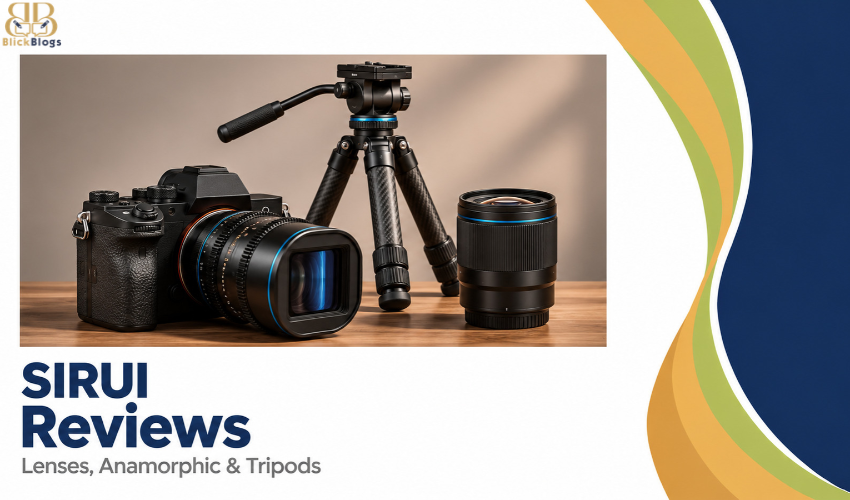
SIRUI is an appealing brand when the equipment you want usually costs more than your project can justify. Its catalog includes compact anamorphic lenses, fast autofocus primes, manual cinema lenses and travel supports. That breadth is useful, but it also makes shopping confusing: a lens that looks ideal in a dramatic promotional film may be completely wrong for your camera, recording mode or way of focusing.
This SIRUI reviews guide addresses the commercial questions behind those searches: which family fits your work, what the specifications actually mean and where the compromises deserve closer attention. It combines official documentation with independently published testing and customer reports. It does not claim first-person testing of these products, and there is no artificial brand-wide numerical rating.
Quick Verdict
SIRUI is worth shortlisting for filmmakers exploring anamorphic capture, APS-C creators building a manual cine kit and photographers comparing affordable fast primes. Choose by sensor coverage, mount and focusing method before considering price. The strongest reservations concern model-specific optical compromises, autofocus compatibility, regional return restrictions and the difference between an advertised specification and proven performance in your own setup.
Start with your camera and shooting style
Compare sensor coverage, mount and autofocus or manual-focus operation before selecting a lens family.
Explore SIRUI’s Official Store →What Is SIRUI?
SIRUI sells photographic and filmmaking equipment, including lenses, tripods, heads, monopods and lighting. Its lens range spans conventional spherical designs and anamorphic optics, with both manual and autofocus options. The important point for a buyer is that these products do different jobs. A general recommendation for the brand cannot tell you whether a particular lens belongs in your bag.
For example, someone filming controlled dialogue can benefit from geared manual controls that are inconvenient during a fast-moving family event. A portrait photographer may appreciate a bright autofocus prime without wanting anamorphic distortion or a widescreen editing workflow. Treat SIRUI camera lens reviews as family-specific research, then narrow your choice to the exact focal length and mount. This prevents an attractive feature list from becoming an expensive mismatch.
The Main SIRUI Lens Families Explained
Saturn 35mm: Compact Manual Anamorphic
The Saturn 35mm is a full-frame, manual-focus anamorphic lens with a 1.6x squeeze factor and T2.9 maximum aperture. SIRUI offers blue and neutral flare versions. The broader Saturn family uses carbon-fiber construction and is positioned around portability, although version and mount details should be checked individually. Do not merge original Saturn specifications with later Saturn V2 listings.
A useful SIRUI Saturn 35mm anamorphic lens review should examine more than flare screenshots. Look at focus transitions, close-focus restrictions, edge rendering and how the lens balances on the actual camera rig. Its appeal is a compact route into a distinctive widescreen image. The trade-off is that framing, manual focus and post-production need planning rather than being treated as incidental steps.
Astra 1.33x: Anamorphic With Autofocus
The Astra series combines full-frame coverage, 1.33x squeeze and T1.8 maximum aperture, with 50mm, 75mm and 100mm choices. The official selector lists E, L and Z mounts and blue or neutral flare options. Autofocus is the central practical difference from Saturn. However, the presence of autofocus does not establish identical tracking behavior across every body and recording mode.
For a SIRUI Astra 1.33x anamorphic lens review, watch moving-subject footage rather than relying entirely on locked-off portraits. Check whether focus transitions look suitable for your subject, whether foreground objects cause distractions and how the lens behaves in backlight. A solo creator may value fewer manual focusing demands. A production requiring carefully timed focus pulls may still prefer a manual setup or need to assess Astra’s manual operation separately.
Night Walker T1.2: Manual Cine Controls for Smaller Sensors
Night Walker is SIRUI’s Super 35/APS-C manual cinema family. Current listings include 16mm, 24mm, 35mm, 55mm and 75mm focal lengths with T1.2 maximum aperture. Availability varies with mount and focal length, so a family-level mount menu is not a promise that every combination exists. It is especially important not to confuse this range with full-frame lenses.
The case for Night Walker is workflow: repeatable manual focusing and cine-style aperture control can suit rehearsed scenes, controlled interviews and small narrative projects. A SIRUI Night Walker T1.2 review should also consider how difficult precise focus becomes at a wide aperture. More light transmission can help exposure, but it does not make an imprecisely focused shot usable. A focused single-lens purchase may be more valuable than an immediately purchased full set.
Aurora 85mm F1.4 and Sniper F1.2
The Aurora 85mm F1.4 is a full-frame autofocus portrait prime. It is a conventional spherical lens, so it does not require anamorphic desqueezing. Buyers considering a SIRUI Aurora 85mm F1.4 review should examine portrait-distance image quality, color fringing and autofocus consistency. Its focal length can suit tighter portraits, but it requires working space that a small room may not provide.
Sniper is a separate APS-C autofocus family, with 16mm, 23mm, 33mm, 56mm and 75mm F1.2 options described in SIRUI’s lens catalog. A SIRUI Sniper F1.2 lens review needs to account for the camera’s crop factor and the focal length being tested. An APS-C 33mm and full-frame 85mm serve different framing needs. Neither the bright aperture nor shared brand name makes them interchangeable.
Venus 1.6x: Check the Exact Focal Length
Venus provides another manual full-frame anamorphic route, with multiple focal lengths rather than a single universal specification. SIRUI’s squeeze-factor guide distinguishes the 1.6x models from the 135mm variant’s 1.8x squeeze. That exception matters when building a set. A SIRUI Venus 1.6x anamorphic lens review should name the tested focal length instead of transferring one lens’s characteristics to the entire family.
| Family | Coverage and operation | Main buying question |
| Saturn 35mm | Full-frame, manual anamorphic, 1.6x, T2.9 | Does a compact manual setup fit your production? |
| Astra | Full-frame, autofocus anamorphic, 1.33x, T1.8 | Does tracking work well with your camera and subject? |
| Night Walker | Super 35/APS-C, manual cine, T1.2 | Can your workflow support manual focus? |
| Aurora 85mm | Full-frame spherical autofocus, F1.4 | Is 85mm appropriate for your portrait distance? |
| Sniper | APS-C spherical autofocus, F1.2 | Which focal length gives the framing you need? |
| Venus | Manual full-frame anamorphic; squeeze varies by focal length | Have you checked the exact model and recording format? |
Design, Handling and Practical Performance
Published photographs and specifications establish the arrangement of controls, but they cannot tell us how every focus ring will feel after months of use. For manual cinema lenses, examine focus throw, gear placement, aperture operation and clearance around your rig. For autofocus primes, consider switches, firmware access and whether important controls remain reachable in a cage. Handling should support the way you shoot rather than merely look professional.
Optical character also requires context. Strong flare may be a deliberate creative choice in a music video and an unwanted distraction in a corporate interview. Background rendering that looks attractive in a portrait can conceal colored outlines around high-contrast objects. Compare footage with similar subjects and lighting to your own work. A carefully graded promotional clip is evidence of what a skilled filmmaker achieved, not a neutral laboratory comparison.
There is useful independent evidence for Aurora. In its Sony E-mount Aurora 85mm test, OpticalLimits reported strong improvement when stopping down, pleasing background rendering and compact construction. It also identified noticeable longitudinal color fringing, reduced close-range performance and the absence of an embedded correction profile. Those findings apply to the tested sample and system; they should not become claims about every SIRUI lens.
This produces a more useful value judgment than simply calling Aurora sharp or soft. A portrait photographer who usually works beyond minimum focus distance may accept its compromises. Someone photographing reflective products close up may care much more about colored fringes and correction workflow. Read sample images at your intended aperture and subject distance. The same lens can be a sensible purchase for one application and an awkward one for another.
Anamorphic Workflow and Camera Compatibility
An anamorphic lens compresses the recorded image horizontally; desqueezing restores the intended proportions. SIRUI’s workflow guide explains why capture ratio and squeeze factor must be considered together. Mathematically, a 16:9 recording multiplied by 1.33 gives approximately 2.36:1, while multiplying by 1.6 gives approximately 2.84:1. A 3:2 recording with 1.6x squeeze yields 2.4:1 before further cropping.
That means a stronger squeeze is not automatically a better match for your camera. If you only record 16:9 and deliver near 2.39:1, a 1.6x image may need substantial horizontal cropping. If your camera supports suitable open-gate modes, you have different framing options. Decide the delivery format before buying the lens. Otherwise, the footage may be wider than you intended without offering a useful final composition.
Next, check mount and sensor coverage independently. A lens fitting a full-frame body does not mean its image circle covers the full sensor, particularly with APS-C or Super 35 products. Crop recording can change framing and available resolution. Also verify body-specific autofocus support, recording restrictions and any requirements listed by the manufacturer. A mount name is the beginning of compatibility research, not its conclusion.
For electronic lenses, consult SIRUI’s firmware downloads for the exact model and mount. The page supports Astra, Aurora and Sniper updates, among other autofocus families. Record your existing version before following the relevant update instructions. Firmware availability is useful support evidence, but it does not prove every possible camera-lens issue has been resolved.
SIRUI Traveler X Tripod Review: Portability Comes First
The original Traveler X is a lightweight carbon-fiber travel kit with an AT-10 video head. SIRUI lists approximately 0.95kg kit weight, 152cm maximum height and a 5kg maximum load for the original kit. The page also offers Traveler X-I and X-II options, which should be treated as separate configurations. Do not combine their head type, weight or capacity figures.
Its portability makes it worth considering when carrying a support is the main obstacle to using one. However, a maximum-load specification is not a measurement of vibration resistance, wind performance or smooth movement with a front-heavy rig. A camera with a long lens can behave differently from a compact setup of equal total weight. Check balance and movement with your own equipment during any permitted evaluation period.
Pricing, Returns and Value for Money
During research, SIRUI’s US-dollar catalog advertised Night Walker from $239, Sniper from $209, Saturn from $399 and Venus from $299. Its anamorphic collection showed Astra from $721.65, while Aurora appeared at $381.65 in the all-products collection. These are changing advertised entry prices, not guaranteed quotes for every mount, focal length or kit. Individual product snapshots sometimes showed different prices, so use the selected variant and checkout total.
Several extracted listings also displayed unavailable or backorder wording. That does not establish that every variant is unavailable, but it rules out assuming immediate shipment from an advertised price alone. Confirm the exact combination before scheduling a production around it. The cheapest focal length is poor value if it arrives after the job or needs accessories that were omitted from the budget.
Include filters, focus accessories, support equipment, taxes and any additional monitoring requirements in the comparison. An inexpensive manual lens can still be excellent value when you already own a suitable rig and enjoy that workflow. It can be less economical when your work needs reliable unattended autofocus. Buy the capability you will actually use rather than the largest apparent reduction from a reference price.
The refund policy is particularly important: it describes non-defect returns for the US and EU, excludes other countries from that stated provision and allows one return within 30 days of receipt. Return shipping and other applicable charges may be deducted. Check eligibility and obtain instructions before sending anything back. Product pages also describe lens defect coverage, but confirm the exact product, seller and regional terms instead of assuming the homepage’s longest warranty applies to everything.
Check your exact lens and mount
Compare the configured price, stock status and regional purchase terms before adding accessories or a second focal length.
Check SIRUI Models and Prices →SIRUI Pros and Cons
| Advantages | Limitations |
| Several anamorphic families with distinct workflows | Squeeze factor and recording mode require planning |
| Manual cine and autofocus lens options | One family’s performance cannot represent the entire brand |
| Bright-aperture choices for different sensor formats | Wide apertures make focus accuracy more demanding |
| Compact lens and travel-support options | Low weight does not establish stability or optical superiority |
| Published firmware support for electronic lenses | Compatibility needs checking by camera, lens and mount |
| Competitive advertised entry prices | Availability, regional returns and total system cost need attention |
Who Should Buy SIRUI—and Who Should Avoid It?
SIRUI is a good candidate for creators who understand the intended workflow and want to expand a specific capability. That might mean one anamorphic lens for short films, a manual prime for controlled interviews or an autofocus portrait lens for a compatible body. Starting with a single focal length gives you a better basis for expansion. A matched-looking set is only useful if its operation suits the way you produce images.
It is less suitable as an impulsive replacement for equipment that already meets a demanding professional requirement. If a job depends on proven tracking, rapid replacement support or a specific correction workflow, confirm those requirements before changing systems. Creators who mainly need flexible everyday framing may benefit more from a conventional zoom. Neither a T1.2 label nor an anamorphic flare substitutes for practical suitability.
| Your main requirement | Family to investigate first |
| Compact manual full-frame anamorphic shooting | Saturn, with generation and mount confirmed |
| Autofocus anamorphic capture near a widescreen delivery ratio | Astra, with body-specific testing |
| Controlled Super 35 or APS-C filmmaking | Night Walker |
| Full-frame portrait photography | Aurora 85mm F1.4 |
| Fast autofocus primes for APS-C | Sniper |
| A travel support for a lightweight setup | Original Traveler X or the separately specified alternatives |
Customer Feedback and Common Concerns
The SIRUI store Trustpilot profile contains both positive product accounts and complaints about service. Positive reports include appreciation for support equipment and value, while adverse reports include return-shipping costs and disputes about the selling channel’s role in support. These are customers’ accounts, not independently verified findings about each transaction. They are a reason to clarify terms, not a basis for inventing a failure rate.
Keep service feedback separate from image-quality evidence. A favorable tripod experience does not establish Astra autofocus reliability, and a difficult return does not measure lens resolution. Look for detailed reports naming the product, camera, firmware and circumstances. For expensive purchases, retain the seller’s compatibility response and order documentation. That gives you something more useful than a general star average if a problem arises.
Competitor Comparison
The relevant competitor depends on the category. For a full-frame 85mm autofocus prime, the Sigma 85mm F1.4 DG DN Art provides a concrete Sony E- or L-mount comparison. Sigma lists 625g for the E-mount version and 630g for L-mount. Compare current local prices and camera-specific results; this is a category alternative rather than a claim that its operation is identical to Aurora.
For anamorphic work, rental is another useful alternative to immediate ownership. Testing a lens on an actual project can reveal whether flare, minimum focus and editing requirements fit your production before you buy a set. A conventional spherical lens with a widescreen crop is also worth considering when you want the frame shape without committing to anamorphic characteristics. It produces a different optical result, but may fit the project more efficiently.
| Option | Why consider it? | What to compare |
| SIRUI Aurora versus Sigma 85mm F1.4 DG DN Art | Two full-frame autofocus portrait-prime routes | Mount, rendering, autofocus and current total price |
| SIRUI anamorphic purchase versus rental | Ownership versus a project-specific evaluation | Rental access, repeated use and compatibility |
| SIRUI anamorphic versus spherical capture with a crop | Different routes to a widescreen delivery | Optical character, framing and editing demands |
| Traveler X versus a heavier support | Portability versus greater support mass | Real rig stability, balance and transport needs |
Frequently Asked Questions
Is SIRUI a good lens brand?
SIRUI is worth considering for specific needs, including anamorphic filmmaking and fast primes. Quality and suitability must be assessed by model, mount and intended use. Published testing shows that a lens can offer good value while retaining visible compromises, so avoid treating one successful purchase as proof that the entire catalog performs identically.
Does the Saturn 35mm have autofocus?
The Saturn 35mm discussed here is manual focus. Plan how you will focus during handheld shots, subject movement and repeated takes before buying it. If autofocus is essential, compare a compatible Astra configuration instead, while still checking its behavior on your particular camera and firmware.
What is the main difference between Astra and Saturn?
Astra combines autofocus with a 1.33x squeeze, while Saturn uses manual focus and 1.6x squeeze. These differences affect operation and the final aspect ratio produced from a given recording mode. Choose by camera format, delivery requirements and focus workflow rather than assuming one family is automatically an upgrade over the other.
Are Night Walker lenses full-frame?
Night Walker is specified for Super 35/APS-C coverage. Mount compatibility alone does not establish full-frame image coverage. If you use a full-frame camera, check whether a suitable crop mode is available and what that does to framing and recorded resolution before choosing a focal length.
Is Sniper F1.2 suitable for APS-C photography?
Sniper is an APS-C autofocus family and is relevant to photographers comparing bright primes in that format. Choose the focal length for your subject and confirm the specific camera and mount combination. An F1.2 aperture offers creative flexibility, but focusing accuracy and the rendering you prefer remain essential considerations.
Is the Aurora 85mm F1.4 worth buying?
It deserves consideration for compatible portrait setups, particularly when the price and handling suit your needs. Independent testing identified both appealing rendering and limitations such as longitudinal color fringing and weaker close-range performance. Examine relevant sample images and body-specific autofocus evidence before deciding whether those compromises matter for your work.
Do SIRUI anamorphic lenses need special editing?
Their footage needs the appropriate desqueeze interpretation to restore intended proportions. The required factor depends on the lens, and the resulting aspect ratio also depends on the recorded format. Confirm that your monitoring and editing tools support the intended workflow before using the lens for an important project.
Is Traveler X suitable for a heavy video rig?
The original kit has a published load limit, but that alone does not establish stable performance with a heavy or front-loaded rig. Assess the combined equipment, balance, shooting height and movement requirements. A lightweight travel kit should be chosen for portability with a suitable setup rather than assumed equivalent to a substantial production tripod.
Does SIRUI offer worldwide 30-day returns?
The detailed store policy places regional limits on the stated non-defect return provision, specifying the US and EU. Do not assume the homepage summary establishes the same arrangement everywhere. Confirm the terms for your destination and seller, including return costs and authorization, before relying on a trial purchase.
Final Verdict
SIRUI is most convincing when you buy a clearly defined capability. Saturn and Venus offer manual anamorphic options, Astra brings a different autofocus workflow, Night Walker addresses controlled smaller-sensor filmmaking and Aurora and Sniper serve conventional photography needs. Traveler X extends the brand’s value proposition to a portable support, with the practical limits that accompany a lightweight design.
The strongest recommendation is to shortlist one exact product and verify it against your camera and production requirements. Compare real evidence at the aperture, focus distance and recording mode you expect to use, then check stock and regional support terms. SIRUI can offer worthwhile creative access, but a successful purchase depends on choosing the right tool rather than awarding the whole brand an unsupported score.
Build a kit around your actual projects
Choose one suitable lens or support, verify compatibility and expand only when the workflow proves useful.
Browse SIRUI Equipment →